
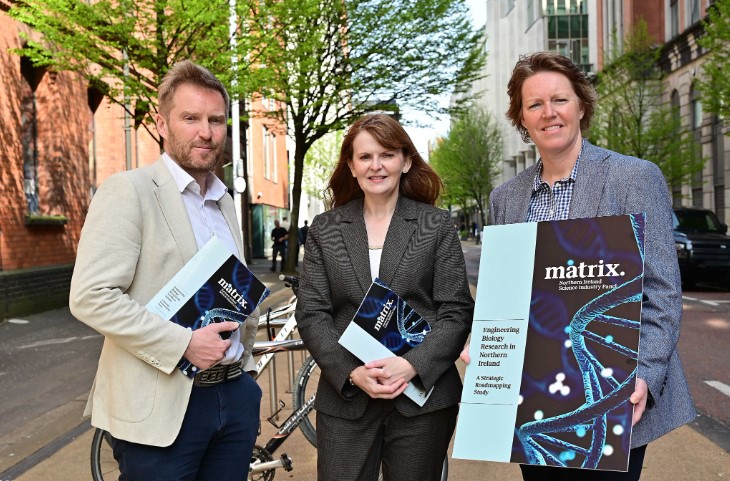
Economy Minister Dr Caoimhe Archibald has launched a major new report highlighting how engineering biology can drive economic growth, improved health outcomes and environmental benefits for Northern Ireland.
Engineering Biology in Northern Ireland: A Strategic Roadmapping Study is the first integrated framework for developing the region’s engineering biology capability, focused on using biological processes to deliver innovation across health, food and industry.
Minister Archibald said: “Engineering biology has the potential to transform how we approach healthcare, food production, manufacturing and our environment. From diagnostics and precision medicine to agri-food innovation and the circular bioeconomy, its applications span some of the north’s most important industries. This roadmap gives us the evidence-based foundation to consider how best to act on that potential.”
The report was commissioned by Matrix, the Northern Ireland Science Industry Panel. It provides a clear, evidence-based pathway, positioning Northern Ireland in one of the world’s fastest-growing technology sectors.
There are six priority areas of opportunity identified in the report: Diagnostics and Biosensors; Food Security and Resilience; Large-Scale Capabilities and Industrial Biotechnology; Circular Bioeconomy; Agri-Tech Innovation; and One Health. The report calls for coordinated action across government, industry and academia while highlighting Northern Ireland’s internationally competitive strengths in diagnostics, precision medicine, agri-food and advanced manufacturing.
Professor Sam Turner, Chair of the study, commented:
“Northern Ireland has genuine, internationally competitive strengths in engineering biology, particularly in diagnostics, health and agri-food. What has been missing is not scientific excellence, but coordination, scale-up capability and long-term strategic commitment. This roadmap provides a clear, evidence-based pathway so that Northern Ireland can help shape the future of engineering biology rather than simply adopting the solutions that have been developed elsewhere.”
Professor Helen McCarthy, Chief Scientific and Technology Adviser and Matrix Ex Officio said:
“Engineering Biology is a critical technology that will drive future economic growth through innovation. In essence, it fuses biological knowledge with chemical, engineering and manufacturing processes to produce new medicines, agricultural products, sustainable fuels and advanced materials, all of which are underpinned by greener, more energy-efficient systems. This MATRIX report is very timely, in the context of the UK Industrial Strategy, and critically, it not only showcases the key strengths in the NI ecosystem but, more importantly, it highlights what is required to accelerate innovation in this field for maximal impact.”
The report’s key recommendations include establishing a cross-departmental engineering biology coordination body to develop a proactive regulatory strategy that maximises the advantages of the Windsor Framework; a comprehensive skills and workforce strategy spanning doctoral training through to technician-level apprenticeships; and a sustained public engagement programme to communicate the practical benefits of engineering biology to the public and policymakers.
Read the full report: Engineering Biology in Northern Ireland: A Strategic Roadmapping Study