
Latest news
The MATRIX website is home to the latest Northern Ireland science & technology news, the most relevant reports and of course our own studies on Northern Ireland’s tech sectors and how best to grow them.
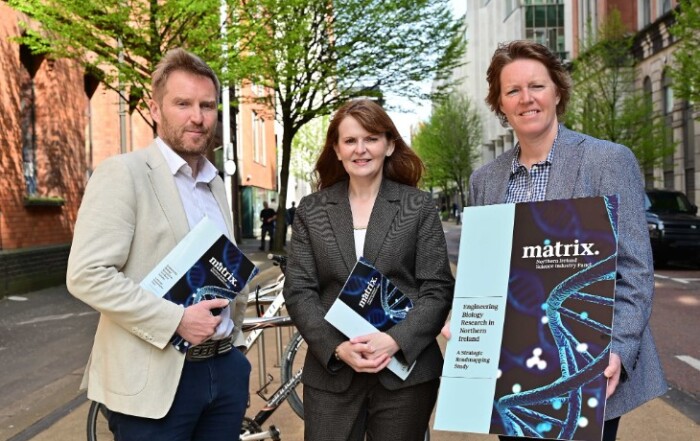
Economy Minister launches ‘Engineering Biology’ Matrix report
Economy Minister Dr Caoimhe Archibald has launched a major new report highlighting how engineering biology can drive economic growth, improved health outcomes and environmental benefits for Northern Ireland. Engineering Biology in Northern Ireland: A Strategic Roadmapping Study is the first integrated framework for developing the region’s engineering biology capability, focused on using biological processes to deliver innovation across health, food [...]

‘RegTech’ opportunity
Northern Ireland has a real opportunity to strengthen its position as a leading Regulatory Technology (RegTech) hub. We are currently exploring the potential for a dedicated RegTech half-day workshop, in collaboration with Invest Northern Ireland. As we continue to engage with colleagues across industry, government and academia following the Matrix 'Regulatory Technology - Landscape Review' report and video series. We are [...]

Matrix welcomes two new ex officio members
Matrix NI is pleased to announce two new representatives on the Northern Ireland Science and Industry Panel: Marina Donohoe, Chief Executive Officer of QUBIS, and Damian Duffy, Principal and Chief Executive of Belfast Metropolitan College. The new incumbents replace Brian McCaul (formerly QUBIS) and Leo Murphy (NWRC) having completed their term and the Chair and panel are grateful for their [...]
What is Matrix?
MATRIX, the Northern Ireland Science Industry Panel, is a business led expert panel, formed primarily to advise government, industry and academia on the commercial exploitation of R&D and science and technology in Northern Ireland.
We produce regular, in depth reports which outline the work, findings and recommendations of our specialist panels. These reports are an invaluable resource for anyone interested in how new technologies and market opportunities can be developed within the Northern Ireland economy and beyond.



























The Matrix library
This library is a collection of Matrix reports as well as documents that the Matrix panel and secretariat have used in their research. The most recent additions to the library are here – if you want to see the full collection, arranged by topic, please visit the library section.
Engineering Biology Research in Northern Ireland
The 'Engineering Biology Research in Northern Ireland: A strategic roadmapping study' presents the findings, analysis, and recommendations of the Engineering Biology Research Project in Northern [...]

Photonics and Lasers Capability
Photonics is the science of generating, controlling and detecting light and it underpins many of today’s most rapidly evolving technologies. This study, commissioned by Matrix [...]

AI and the Future of Work in Northern Ireland
The 'AI and the Future of Work in Northern Ireland' report was commissioned by Matrix, on behalf of the Department for the Economy, providing an assessment [...]
Live SBRIs and other funding competitions
The Small Business Research Initiative (SBRI) connects public sector challenges with innovative ideas from industry, supporting companies to generate economic growth and enabling improvement in achieving government objectives.
SBRI provides innovative solutions to challenges faced by the public sector and generates new business opportunities for companies, providing SMEs with a route to market for their ideas and bridging the seed funding gap experienced by many early stage companies. It supports economic growth and enables the development of innovative products and services through the public procurement of research and development (R&D).
There are currently no vacancies.